
The Signal · Detroit 2126 · Installment 2 · October 2026
Who Is It For?
Published October 5, 2026 · By Justin Spencer Smith · Also on LinkedIn
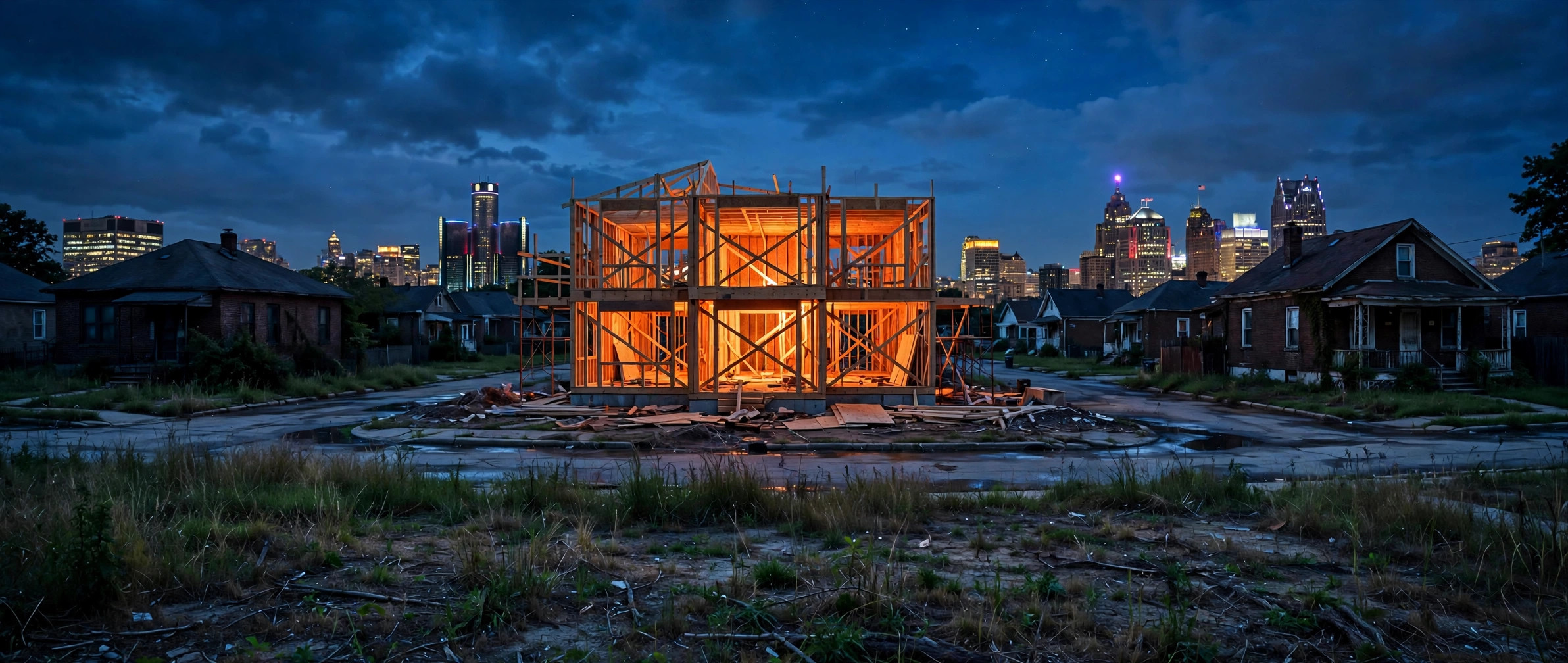
Detroit 2126, part two. Last time: the ride is free. This time: the roof over your head.
Here's the question, stated plainly, because it deserves no softening: why are we building unaffordable housing? Who is it for?
The math
Detroit's median household income is $39,938, per the Census Bureau. A third of the city lives in poverty.
Now look at what's being built. Urban new-construction homes in the Detroit metro list at a median of $511,180 — a 176% premium over existing homes, per Realtor.com's March 2026 data. Zillow's July numbers tell the same story per square foot: $239 for new builds versus $165 for existing homes. And new construction is just 3.5% of sales, down from 4.4% in 2019.
The standard rule of thumb says a household can afford a home worth about three times its income. A median Detroit household — $40,000 — can afford roughly $120,000. New builds are priced at more than four times that. At $301 a square foot (the median for new construction sold in the city proper between June 2025 and June 2026), a modest 1,200-square-foot house costs $361,000. That's nine times the median income.
So: who is it for? It is not for the median Detroiter. That's not an accusation. It's arithmetic.
The volume
Between June 2025 and June 2026, exactly 19 new-construction homes sold in the entire city of Detroit, according to the Realtor MLS. Nineteen. The city holds some 50,000 vacant lots.
Read that again. Fifty thousand empty lots. Nineteen new homes in a year. We are not experiencing a building boom that happens to be expensive. We are experiencing almost no building at all — and the little that gets built is priced for someone else.
This is the shape of the problem: it's not that developers are flooding the market with luxury units. It's that the economics of building in Detroit barely work at any price point, so the only projects that clear the bar are the ones aimed at the top of it.
Why
Detroit housing developer David Palmer put it bluntly this summer: hard costs are the bulk of the bill, and there are few policy tools that touch them. Soft costs — permits, fees, approvals — are pure policy choices, and they can be lowered. But nobody has figured out how to make the actual sticks and bricks cheap enough to sell at $120,000.
Then there's the appraisal gap: a rehabbed home often can't be valued high enough to serve as collateral for its own construction loan, because the comps around it are too low. The financing math breaks before the first nail is driven.
And the buyers who do show up with money are increasingly not residents. A local realtor described watching young couples with clean FHA offers on $85,000 west-side bungalows lose to LLCs that wired cash and closed in days. They weren't beaten on price. They were beaten on speed — the one thing a financed buyer can't manufacture.
Detroit's rent-to-value ratio is the second-highest in the country at 8.5%, which makes the city a magnet for independent investors: over 90% of the city's landlords own just one or two properties, accounting for 75% of the rental stock. Institutional buyers run only about 7% of metro purchases — this isn't Wall Street, it's thousands of small cash buyers, many from out of state, competing with residents for the same $85,000 bungalows and turning them into rentals.
Meanwhile metro rents rose 1.7 to 3% in 2026 — leading the country — on a shortage that has persisted for decades. Waiting lists stretch through private rentals and assisted housing alike.
So the honest answer to "who is it for": the new stuff is for the top of the market, because that's the only segment where the math closes. The existing stock is increasingly for investors, because cash beats a mortgage application. And the median household — $40,000 a year — is left bidding on what's left.
The 100-year version
Housing is the slowest-moving thing a city builds. A house framed today will shelter people in 2126, or it will be a vacant lot again by 2040. That makes it the purest 100-year question in this series.
Here's what a century of building for everyone looks like. First, the cost problem gets attacked at the root: automated and modular construction — the academy's home territory — is the only lever big enough to move hard costs. We build the machines that build the things. A housing market that can't produce a $120,000 house is a robotics problem wearing a policy costume.
Second, the land problem is already solved and sitting empty: 50,000 vacant lots, many held by the Land Bank, is one of the largest affordable-housing land assemblies in America. The question was never "where would we build." It's "who gets to build, and for whom."
Third, the ownership model: community land trusts, limited-equity co-ops, and other structures that take land cost out of the price permanently — so a house built affordably in 2030 is still affordable in 2126, instead of flipping into the investor market the moment the neighborhood improves.
None of this requires inventing a new Detroit. It requires deciding that the next hundred years of residents matter more than the next flip cycle.
The work ahead
Last installment, the region voted to connect its transit system. Housing needs its own version of that vote — not a millage, but a decision: that 50,000 lots become homes for the people who live here, built at prices the median household can actually pay.
The ride is free. Now the roof.
The Signal is the newsletter of Detroit Automation Academy — where Detroit builds what's next. If you know a young builder who should be in the room, send them our way.
Cover skyline photo: Nheyob, CC BY-SA 4.0, via Wikimedia Commons.